



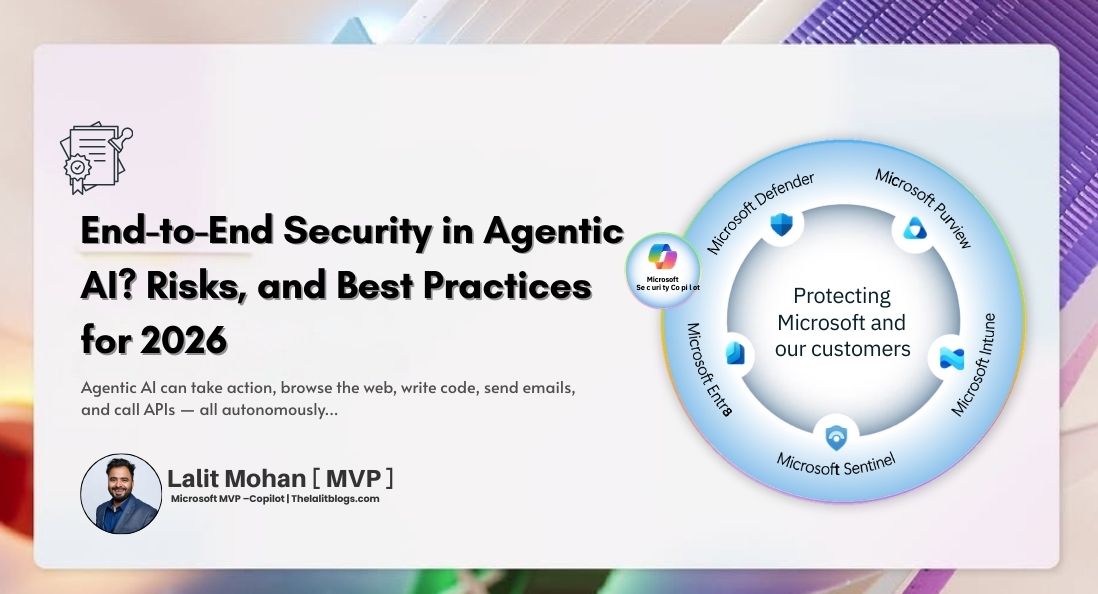
Agentic AI can take action, browse the web, write code, send emails, and call APIs — all autonomously. That's incredibly powerful. It also means a compromised AI agent can cause damage at machine speed, at machine scale. Here is what end-to-end security for agentic AI looks like in 2026, and what every enterprise needs to put in place before deploying agents at scale.
Why Agentic AI Changes the Security Game Entirely
Traditional security thinking was built around protecting people and devices — humans clicking links, laptops connecting to networks, applications exchanging data. Agentic AI breaks that model in a fundamental way. An AI agent is not a person and not a device. It is a persistent, semi-autonomous actor that can plan multi-step workflows, access sensitive systems, and take consequential actions — all without a human approving each step.
This is transformational for productivity. It is also a new category of security risk that most enterprise security frameworks were simply not designed to address.
These three numbers together tell a clear story. The attack surface is growing faster than security teams can respond. GenAI is already the number-one source of data incidents, and that trend was measured before agentic AI deployments became mainstream. The organisations deploying agents now, without end-to-end security in place, are taking on compounding risk.
Unlike a human employee, an AI agent doesn't get tired, doesn't question unusual instructions, and can act on data from many systems simultaneously. A prompt injection attack — where malicious instructions are embedded in a document the agent reads — can redirect an agent's entire workflow without any visible sign of compromise. This is a new threat class with no analogue in traditional security frameworks.
The New Attack Surface: What AI Adds on Top of Everything Else
Most enterprises already have security programmes covering identity, endpoints, cloud infrastructure, and data. Agentic AI doesn't replace those risks — it adds to them. The diagram below shows exactly what the new attack surface looks like when you layer AI agents on top of your existing infrastructure.

The new AI-specific threat vectors — sitting on top of the traditional attack surface — break down into five distinct areas that enterprise security teams need to address explicitly:
💬 GenAI Prompts & Responses
Prompt injection attacks embed malicious instructions inside documents, emails, or web pages that an AI agent reads during its workflow. The agent treats these as legitimate instructions and executes them — potentially exfiltrating data, impersonating users, or corrupting outputs.
🧠 AI Orchestration Layer
Multi-agent systems use an orchestration layer to coordinate tasks between specialised agents. If the orchestration layer is compromised, an attacker gains control of the entire agent pipeline. Security controls must be applied at the orchestration level, not just individual agents.
📦 Plug-ins & Function Calls
AI agents use plug-ins and APIs to take real-world actions — sending emails, creating calendar entries, modifying SharePoint files, querying databases. Each plug-in is a potential entry point. Compromised plug-ins can be used to execute malicious actions while appearing legitimate.
🤖 AI Models & Training Data
The AI models themselves are an attack surface. Model poisoning attacks corrupt training data to introduce subtle biases or backdoors. Adversarial inputs are crafted to cause mis-classification. For enterprises using fine-tuned or internally hosted models, protecting the model pipeline is now a security requirement.
Traditional DLP checks whether a user is sending a sensitive file to an external email address. It has no concept of an AI agent summarising that file and including its contents in a response to a broad group of users. AI-native security controls must understand intent, context, and AI-specific behaviours — not just data movement rules.
The End-to-End Security Platform: Five Layers, One Unified View
Defending against the full agentic AI threat surface requires security controls at every layer — identity, endpoints, data, cloud infrastructure, and AI workloads specifically. Siloed point tools, each covering one layer but unable to see across the others, create the dangerous gaps that attackers exploit. End-to-end security means all five layers talking to each other, in real time, with AI correlating signals across all of them.

Microsoft's security platform brings together five distinct products into a single integrated security fabric, unified by Security Copilot on 84 trillion daily signals. Here is what each layer is protecting in the context of agentic AI specifically:
| Security Layer | Product | Agentic AI Protection | Type |
|---|---|---|---|
| Identity | Microsoft Entra | Governs which agents can access which systems, detects anomalous agent authentication patterns, enforces least-privilege access policies for AI workloads | Traditional AI-Extended |
| Endpoints | Microsoft Defender + Intune | Detects agent-initiated processes or file operations that deviate from normal patterns, applies device compliance to machines running AI workloads | Traditional |
| Data | Microsoft Purview | Monitors AI agent data access, classifies sensitive content before agents can reach it, enforces DLP policies on AI-generated outputs, detects oversharing in real time | AI-Native NEW |
| Cloud & AI Workloads | Defender for Cloud | Protects Azure AI Foundry deployments, scans AI-generated code for vulnerabilities, monitors model endpoints for adversarial inputs and anomalous API calls | AI-Native NEW |
| SIEM & Response | Microsoft Sentinel | Ingests agent activity logs, correlates agent behaviour with broader attack signals, enables natural language hunting for AI-related threat patterns | AI-Extended |
Security Copilot's threat intelligence is fed by 84 trillion security signals daily — from hundreds of millions of endpoints, billions of emails, and global cloud infrastructure. This means that when a new agent-targeting attack pattern emerges anywhere in the world, detection and defensive updates reach every customer globally within minutes. No standalone AI security tool comes close to this signal volume.
Protecting Data When AI Agents Are Involved
Data security is the area where agentic AI creates the most immediate, most underappreciated risk. When a human employee accidentally shares a confidential document with the wrong person, it's a bad day. When an AI agent systematically accesses, processes, and incorporates sensitive data into its outputs without proper controls, the exposure can be organisation-wide before anyone notices.

The data shows this is already happening at scale. GenAI-related incidents account for 40% of all data security incidents in 2024, up from 27% the year before. That trajectory will steepen sharply as agentic AI deployments accelerate through 2026.
The Three AI Data Security Challenges
AI Oversharing — The Silent Risk
When an AI agent responds to a broad user query, it may include sensitive information from documents it has legitimate access to but that weren't intended for that audience. A customer-facing Copilot agent that has access to internal pricing data or personnel files can inadvertently expose them. Over 80% of enterprise leaders now identify this as a primary concern. The fix is rigorous data classification and access scoping before agents are deployed — not after an incident.
Insider Risk in the Age of AI
More than 20% of data breaches originate from insiders, and more than half of those are intentional. AI agents dramatically raise the stakes for insider threats — a malicious insider who can manipulate an AI agent's instructions gains the ability to exfiltrate data at machine speed, through outputs that look like legitimate AI-generated content. Behavioural analytics that monitor both the human and the agent together are required to catch this pattern.
GenAI Incident Surge — And It Is Still Accelerating
The jump from 27% to 40% of incidents being GenAI-related happened in a single year, and most organisations were still in pilot phases for agentic AI in 2024. Full-scale agentic deployments in 2025 and 2026 will accelerate this trend significantly. Security teams that don't have AI-native data security controls in place will find themselves responding to incidents they had no visibility into until the damage was done.
Microsoft's recommended deployment sequence is explicit: implement Microsoft Purview Information Protection and DLP policies before granting AI agents access to your data estate. This includes: running Purview's data discovery to find and classify sensitive content, defining information barriers that restrict what agents can access, and setting up DLP policies that cover AI-generated outputs as a content category. Doing this after an incident is far more expensive than doing it first.
AI-Powered Security Operations: Detecting Agent Threats in Real Time
Even with perfect preventive controls, some attacks will get through. The question for agentic AI deployments is: how quickly can you detect anomalous agent behaviour, understand what happened, and contain it before damage spreads? This is where AI-powered security operations make the decisive difference.

The unified SOC dashboard brings together signals from every layer of the security stack — identity, endpoints, email, cloud, and AI workloads — into a single real-time view. Security Copilot agents run continuously in the background, triaging alerts, correlating signals, and surfacing the highest-priority incidents for human review. When a high-confidence attack pattern is detected, automatic disruption kicks in within minutes — not hours, not days.
What AI-Powered SOC Means for Agentic AI Threat Detection
Detecting threats from AI agents requires a different approach than traditional threat detection. AI agents produce high volumes of activity that looks superficially normal — data access, API calls, file operations — making pattern anomaly detection essential rather than rule-based signature matching. The AI-powered SOC applies behavioural baselines specific to each agent's expected workflow, flagging deviations that would be invisible to signature-based tools.
- ✔Automatic attack disruption in minutes: When human-operated attacks — or agent-hijacking patterns — reach a high-confidence threshold, Defender automatically isolates affected assets and blocks lateral movement without waiting for analyst approval
- ✔Natural language threat hunting: Analysts can query the entire security estate in plain English — "show me all AI agent calls that accessed financial data outside business hours last 7 days" — without needing to write KQL queries
- ✔Predictive attack graphing: Security Copilot models the most likely next steps of an active attack based on current signals, enabling proactive disruption before the attack reaches its target
- ✔Security AI agents for autonomous triage: The Phishing Triage Agent and Threat Intelligence Briefing Agent autonomously handle tier-1 alert classification, freeing human analysts for complex AI-related investigations
- ✔Cross-signal correlation at scale: 84 trillion daily signals correlated by AI means that a novel agent-targeting attack seen against one customer generates detection intelligence that protects all customers globally within minutes
7 Non-Negotiable Controls Before You Deploy AI Agents at Scale
Based on Microsoft's security framework for agentic AI and the threat intelligence data above, here are the controls every enterprise must have in place before moving agents from pilot to production.
Identity & Least-Privilege Access for Every Agent
Each AI agent needs its own managed identity with permissions scoped strictly to the data and systems it needs for its specific task. Never grant agents broad administrator access. Review agent permissions regularly as workflows evolve. Use Microsoft Entra's workload identity features for agents running on Azure.
Data Classification Before Agent Deployment
Run Microsoft Purview data discovery to find, classify, and label all sensitive data before agents can access it. Define information barriers that restrict what classes of data each agent can reach. This single step prevents the majority of AI oversharing incidents.
AI-Native DLP Policies Covering Agent Outputs
Traditional DLP policies monitor data movement between users. AI-native DLP must also cover data incorporated into AI-generated outputs — summaries, emails drafted by agents, documents created from AI synthesis. Configure Purview DLP to treat agent outputs as content requiring inspection.
Prompt Injection Defences in Agent Design
Build prompt injection resistance into agent architecture: validate and sanitise all external inputs before they reach the agent's reasoning context, implement content safety filters on all external data sources the agent reads, and use separate context windows for trusted vs. untrusted content.
Human-in-the-Loop for High-Stakes Actions
Not all agent actions should be fully autonomous. Define a clear taxonomy of action risk levels — read operations (low risk, fully autonomous), write operations (medium, log and review), financial or external communications (high, require human approval). Implement approval gates in Copilot Studio for high-risk action categories.
Agent Activity Logging & Monitoring
Every agent action should be logged with full context: what was accessed, what was output, what external calls were made, and which user instruction triggered the workflow. Feed these logs into Microsoft Sentinel for anomaly detection and incident correlation. You cannot investigate an incident you have no logs for.
Regular Agent Security Reviews
As agent capabilities expand and workflows evolve, permission creep becomes a serious risk. Schedule quarterly reviews of agent identities, access scopes, and DLP policy coverage. Test agents for prompt injection resistance using adversarial evaluation. Treat agent security reviews with the same rigour as access certification for human privileged accounts.
The Bottom Line: Agentic AI Security Is Not Optional
The organisations that deploy agentic AI without end-to-end security in place are not just taking a technical risk — they are taking a business risk. A compromised AI agent that exfiltrates customer data, sends malicious communications to clients, or corrupts financial records can cause regulatory, reputational, and operational damage that far outweighs the productivity gains from the agent itself.
The good news is that the security framework exists. Microsoft's five-layer platform — Entra for identity, Defender for endpoints, Purview for data, Defender for Cloud for AI workloads, and Sentinel for detection and response — covers every dimension of the agentic AI attack surface when deployed and configured correctly. Security Copilot on 84 trillion daily signals means threats are detected, correlated, and disrupted faster than any human team could manage alone.
The most successful agentic AI deployments in 2026 are the ones that treated security as a design principle, not an afterthought. This means involving your security team from the very first architecture conversation, running threat modelling sessions for each agent workflow before build, and deploying security monitoring in parallel with agent deployment — not as a follow-up project six months later.
